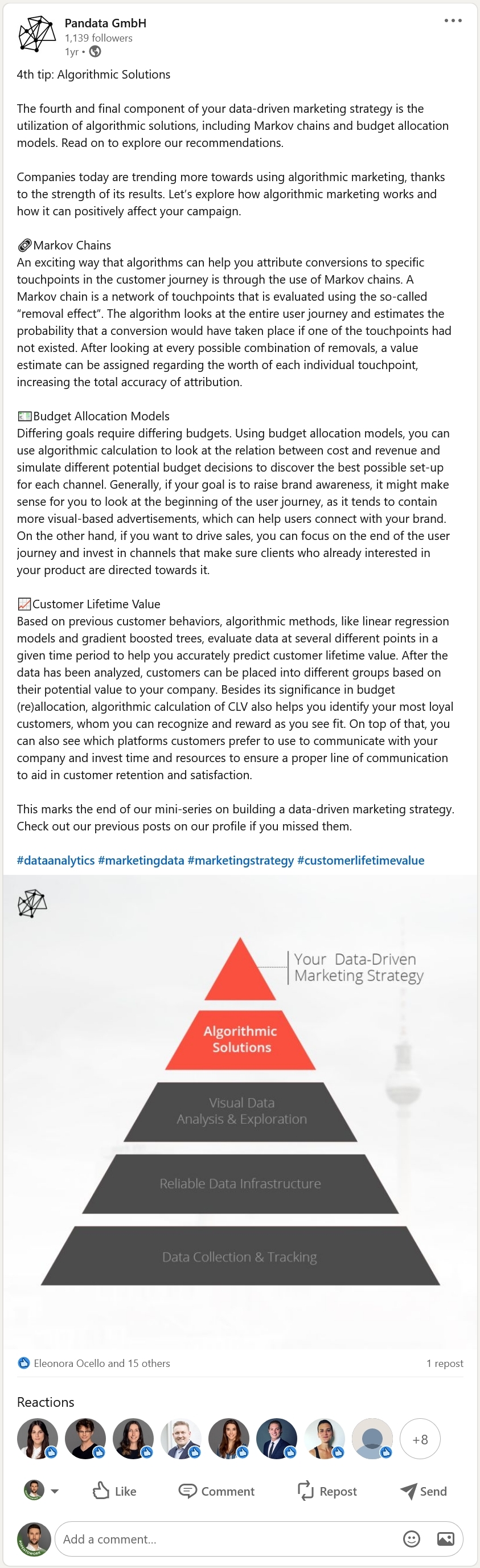
The fourth and final component of your data-driven marketing strategy is the utilization of algorithmic solutions, including Markov chains and budget allocation models. Read on to explore our recommendations.
Companies today are trending more towards using algorithmic marketing, thanks to the strength of its results. Let’s explore how algorithmic marketing works and how it can positively affect your campaign.
An exciting way that algorithms can help you attribute conversions to specific touch points in the customer journey is through the use of Markov chains. A Markov chain is a network of touch points that is evaluated using the so-called “removal effect”. The algorithm looks at the entire user journey and estimates the probability that a conversion would have taken place if one of the touch points had not existed. After looking at every possible combination of removals, a value estimate can be assigned regarding the worth of each individual touch point, increasing the total accuracy of attribution.
Differing goals require differing budgets. Using budget allocation models, you can use algorithmic calculation to look at the relation between cost and revenue and simulate different potential budget decisions to discover the best possible set-up for each channel. Generally, if your goal is to raise brand awareness, it might make sense for you to look at the beginning of the user journey, as it tends to contain more visual-based advertisements, which can help users connect with your brand. On the other hand, if you want to drive sales, you can focus on the end of the user journey and invest in channels that make sure clients who already are interested in your product are directed towards it.
Based on previous customer behaviors, algorithmic methods, like linear regression models and gradient boosted trees, evaluate data at several different points in a given time period to help you accurately predict customer lifetime value. After the data has been analyzed, customers can be placed into different groups based on their potential value to your company. Besides its significance in budget (re)allocation, algorithmic calculation of CLV also helps you identify your most loyal customers, whom you can recognize and reward as you see fit. On top of that, you can also see which platforms customers prefer to use to communicate with your company and invest time and resources to ensure a proper line of communication — and do in-customer retention and satisfaction.
This marks the end of our mini-series on building a data-driven marketing strategy. Check out our previous posts on our profile if you missed them.
#dataanalytics #marketingdata #marketingstrategy #customerlifetimevalue
This post was created as part of a series which involved interviewing several data analytics and engineering experts among Pandata employees.
